-
Winter Lecture Series
We are starting our Winter Lecture Series early this year. We are adding December 6th, with a short club meeting to follow.
All lectures are held at the Musuem of the Rockies at the Hagar auditorium, start time 7:00 p.m., are free and open to the public.
December 6, 2013 – Dr. Robert Szilagy from MSU, Associate Professor Chemistry and Biochemistry: “A chemist’s perspective on the Hadean and its relevance to chemical origin of life.”
The presentation will merge our scientific results on the investigation of various physical chemistry scenarios that could have contributed to the formation of complex organic molecules and the broader context of chemical origin of life. These results were obtained by a team of surface scientists, geochemists, physical chemists, spectroscopists, synthetic inorganic chemists, and theoreticians brought together by the NASA Astrobiology Institute. The breadth of scientific expertise covered by our team well represents the much needed interdisciplinary approach of this work. The presentation will attempt to place the most productive time of chemical evolution within time boundaries using data from geological record and planetology. An exciting future direction for research will be introduced for closing which have a chance to merge at least two leading theories in origin of life research with a possibility of providing a plausible scenario for catalytic conversion of small molecules to biologically relevant large molecules.January 31, 2014 – Dr. Neil Cornish from MSU Physics Department: “Black Hole Hunting with Pulsar Timing Arrays.”
In a unique mariage of radio and gravitational wave astronomy, the regular radio pulses from rapidly rotating Neutron stars (Pulsars) are being used to search for gravitational waves. In the US, the NANOGrav collaboration uses the Green Bank and Arecibo radio telescopes to find an monitor dozens of radio pulsars, and together with partners in Europe and Australia, we form the International Pulsar Timing Array: a galactic scale gravitational wave detector designed to detect signals from black holes billions of times more massive than our Sun. The race is now on to make the first direct detection of gravitational waves – will it be by Pulsar Timing or by the LIGO/Virgo laser interferometers?
.February 28, 2014 – Dr. Nate McCrady, Associate Professor, University of Montana Department of Physics and Astronomy: “Minerva: Big Science with Small Telescopes.”One of the most profound questions NASA poses is: Are we alone? To look for life, we look for planets around other stars with conditions suitable for sustaining life. Detailed spectroscopic follow-up studies of these exoplanets will enable us to determine if there are anomalous amounts of methane or oxygen imprinted in their atmospheric spectra, an indication of life residing on the planet’s surface. With our partner institutions Harvard, Penn State and Caltech, the University of Montana is building and operating Project Minerva, a dedicated observatory for detection of rocky, Earth-like exoplanets orbiting nearby stars....March 28, 2014 – Dr. Sarah Jaeggli from MSU, Solar Physics Postdoctoral Researcher: “IRIS mission update.”The Interface Region Imaging Spectrograph (IRIS) is a new mission to look at the Sun which was launched June 27, 2013. IRIS was designed to look at a very mysterious region above the Sun’s visible surface where the very hot gas of the corona (1 million degrees Celsius) meets the very cool gas of the chromosphere (5000 degrees Celsius). The mystery lies in how the Sun maintains the chromosphere at such a cool temperature while transferring energy through it into the hot corona. The MSU solar physics group is part of the international team responsible for building the instrument, operating it, and analyzing the images it sends back to Earth. In this lecture I’ll give an update on the IRIS mission and talk about the new science that is being done here at MSU. -
Around the sun with ISON: Amateur astronomer tracks comet, asteroids
From the Bozeman Daily Chronicle: Sunday November 10, 2013 by LAURA LUNDQUIST, Chronicle Staff Writer
 TWIN BRIDGES – Only in darkness can you see the stars. Martin Luther King Jr. spoke those words to give people hope to stave off the darkness. But amateur astronomers need no encouragement – they live for the darkness that allows them to see the jewels of the night sky. And in times like these, astronomer Joe Witherspoon might add a corollary: Only in darkness and over time can you see a comet. Comets – really bright comets – can still cause a stir even though fewer people can now see the night sky because of city lights. Some spectacular comets have even landed in popular culture. Halley’s comet swings past the Earth every 75 years. Mark Twain bragged that he was born in one of those years, 1835, and he died the day after the comet returned in 1910. In 1997, Comet Hale-Bopp lingered bright in the northern sky, attracting the attention of a Los Angeles cult. Cult members committed mass suicide, believing they could reach an alien spacecraft that was supposed to be following the comet. But most comets pass by Earth unseen. Fifteen comets are now passing through the solar system, but they’re too small or dim to be seen with the naked eye. But one, ISON, is getting brighter by the day and has many astronomers excited. A comet is a conglomeration of rock and ice that produces one or more tails of vapor and gas as it nears the heat of the sun. One of the intriguing things about ISON is its green color, produced by the release of cyanogen gas and carbon. Six months ago, some were even calling it “the comet of the century.” As it’s gotten closer, however, its behavior hasn’t quite matched some of the predictions. So some astronomers are backing off that claim. But they’re still hoping it will be as bright as predicted if it survives its trip around the sun. “(Professional astronomers) are kind of fudging now. We’re still waiting to see what happens,” Witherspoon said. “One constant thing about a comet: It’s unpredictable. You don’t know how much ice is on this thing, so how bright is it going to get?” After Nov. 17, Comet ISON — named after the Russian organization that spotted it — is expected to be bright enough to be seen by the naked eye. But as it travels toward the sun, it will sink lower in the eastern sky and be visible only before dawn. It will slingshot around the sun on Thanksgiving Day and pass closest to the Earth on Christmas Day before leaving the solar system. “They had wanted all the clubs to do something on Thanksgiving. They wanted to call it the Thanksgiving Day comet and get everyone out,” said Lynn Powers, president of the Southwest Montana Astronomical Society in Bozeman. “But they knew it would be so difficult for families to give up Thanksgiving.” Science writer David Dickinsen said the first week of December, after the comet passes the sun, would be the best week for viewing the comet at its brightest when it will be visible at dusk. In the early morning hours of the past month, Witherspoon has sat vigil at his computer in a hut outside his home southeast of Twin Bridges. Often he stays up all night, peering into the universe only to turn his focus on ISON at about 3 a.m.

Nearby sits an almost identical hut he built with a special feature: a pair of rails that allows the roof to be slid aside to expose two large telescopes. After retiring three years ago, Witherspoon and his wife traded the noise and lights of Tacoma, Wash., for silence and sagebrush of the Ruby River Valley. Many people covet the area’s mountain scenery or the fishing, but for Witherspoon, it’s his high-tech huts and the unbroken sky above them that make it his dream home. The low profile of the Highland Mountains is barely noticeable next to the wide Beaverhead River Valley spreading southwest from Witherspoon’s vantage point. Only the foothills of the Tobacco Root Mountains behind his house mar a prairie expanse of sky. But more important than a lack of physical obstacles is the lack of artificial light. That’s really what attracted Witherspoon to Twin Bridges. “In Tacoma, you often had clouds, and when you didn’t, you had so much light pollution, you couldn’t see anything that was really dim,” Witherspoon said. “If you look at the picture of the U.S. at night, the dark spots are where you don’t have lights. There’s one in Arizona, one in Wyoming and one here. We came here.”
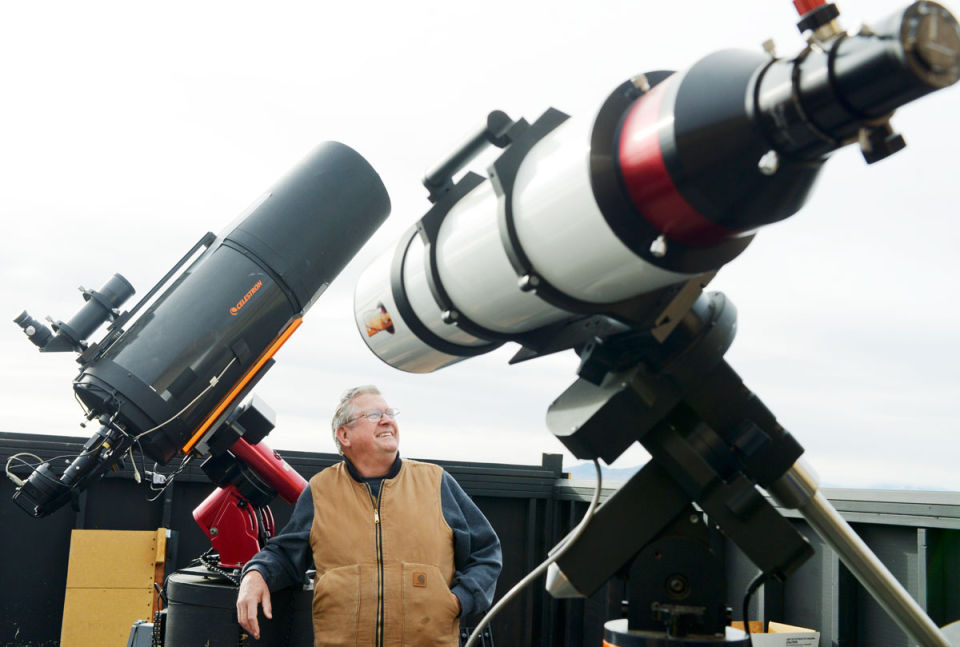
 Obsessed with astronomy since childhood, Witherspoon finally invested in his first advanced telescope 20 years ago after retiring from the U.S. Army. Since then, he’s had a lot of time to design his pet project, the most equipped private observatory in Montana. Dubbed the Cottontail Observatory, Witherspoon’s 14-inch diameter telescope and his 6-inch diameter solar telescope have moveable mounts and cameras that he can run remotely. The two telescopes sit on concrete pillars sunk 6 feet into the ground and passing through the floor so the telescopes don’t vibrate when people walk inside the hut. Witherspoon engineered everything, including the sliding roof setup, which a few astronomers around Bozeman have copied, Powers said. From the warmth of his computer hut, Witherspoon can command the movements of the telescopes. He can also trigger a camera on the telescope to take photographs with timed exposures, which are necessary to pick up very dim objects, such as incoming comets. At regular intervals, Witherspoon photographs specific sectors of sky. Using software, he can line the photographs up to see if any points appear to shift over time, indicating a possible comet or asteroid. While working on his images, Witherspoon sometimes uses Skype to talk to other sleep-deprived astronomers across the nation and compare findings. So it’s not surprising that Witherspoon and an army of amateur astronomers have been recruited to focus on areas of the solar system where professional astronomers don’t have the time to look. “They’re finally realizing that we’re in a shooting gallery. These asteroids can pop on us at any time,” Witherspoon said. “Most of these near-Earth asteroids are small, but every once in a while you see one that’s 4 kilometers. It’s shaky that they come in that close.” In February, a large asteroid exploded in the skies over Russia. It surprised astronomers because, like a sneaky fighter pilot, it came from the direction of the sun so no one saw it. But three papers on the Russian asteroid published this week suggest that the risk of asteroid impacts is 10 times greater than previously thought and similarly large asteroids could penetrate the Earth’s atmosphere roughly every 25 years. Since the Earth’s surface is mostly water, the asteroids don’t present much danger. Still, Witherspoon could have a busy retirement spent mostly in the dark. But for at least the next two months, Comet ISON will brighten his nights.
Read more at: http://www.bozemandailychronicle.com/news/sunday/article_b28c352c-48d7-11e3-a33a-001a4bcf887a.html
-
Comets

Nice meeting tonight. Weather was great and we went outside with a telescope to view Venus in it’s gibbous stage and the ISS flew overhead.
Two items came up at our meeting tonight regarding comets. If you have any other websites or information to share, let me know so we can post it for others.

One is a Comet ISON 3D Model. I went in and played with this a bit when I came home, check it out and see where the comet is located within our solar system.
The other item was Comet C/2012 x1 which seems to have had an outburst, similar to Comet Holmes in 2007.
-
Facebook update
Yes, SMAS does have a facebook page, be sure to Like us. We are also looking for people who would like to be page admins who can help to post astronomy related items, let me know.

-
Comet ISON
Join us for our October club meeting as we discuss comets. Friday October 25th, 7:00 p.m at the Museum of the Rockies. Comet ISON is on it’s way, with some great pictures showing up. We’ll discuss all things comets. What comets are, how to find comet ISON, and much more. All SMAS club meeting are free and open to the public.

-
October 2013 SMAS events

Join SMAS for International Observe the Moon Night on Saturday October 12, 2013 6:00-7:00 pm at the Museum of the Rockies. Bring your binoculars or view through our scopes and binoculars. Park in the museum parking lot and look for the telescopes, depending on weather, we might be on the north side.
Our next club meeting will be on Friday October 25th, 7:00 pm at the Museum of the Rockies. We’ll be discussing comets as we anticipate the arrival of Comet ISON later this fall.
Both events are free and open to the public.
Here is a picture taken through the eyepiece to my 6 inch dob at the InOMN on 10/12/13

-
New links in Ask the Expert
 Seventeen new web links have been added to our Ask the Expert page. These links came from our current Expert and he is willing to train more SMAS club members to become Experts and help answer the emails that come in from this page. Please contact me if you want to be an Expert in Training.
-
Fall 2013 SMAS events
SMAS has several events over the next few months including:
Saturday September 21 – Montana Science and Engineering Festival: Space Race 9:00 a.m., Festival 10:00-2:00 p.m. at Bobcat Stadium. SMAS and the Cottontail Observatory will be making stomp rockets and helping with solar observing. We could use more help, please let me know if you can come to the event and help with stomp rockets or solar observing.
To visit the Bozeman Daily Chronicle article featuring Charles Kankelborg, click here.
 Friday September 27 – SMAS club meeting, 7:00 p.m. at the Museum of the Rockies, Redstart Room. Bring a friend. Topic: Star Party Top Picks. Bring your list of objects that you use when you bring out your telescope to share with friends or at a star party, we will be making a master list and adding it to our website resource page. Social gathering immediately following.
Friday October 25 – SMAS club meeting, 7:00 p.m. at the Museum of the Rockies, Redstart Room. Bring a friend. Topic: Comets. With Comet ISON soon to be visible naked eye, we will discuss comets and information on how to find Comet ISON. Social gathering immediately following.
Friday December 6 – SMAS club meeting and elections for 2014, 7:00 p.m. at the Museum of the Rockies. We are starting the Winter Lecture Series early this season, and will have a guest speaker for the December meeting. More info will be posted soon. Social gathering immediately following.
-
New pictures in the Gallery
 New pictures were added to the Gallery (see tab above) from the August Stars Over Yellowstone and the Glacier Labor Day event at Logan Pass. If you have pictures that you would like to add, please send them to me.
Here is a picture of the Milky Way taken by Ray Stinson on August 31, 2013.
Thanks.
-
Closing out Summer
It has been a very busy summer! Lots of great viewing. We had three successful Stars Over Yellowstone programs with three wonderful speakers. Lots of great feedback. Our telescopes had over 4,000 sets of eyes view through them this summer. It was nice to catch up with old friends and to make new friends.

2013 Montana Star Watch
The Montana Star Watch was successful and memorable – friends, tornado and aurora.
Here is a picture heading up to the Cottontail Observatory, note Joe’s house on the right and the campers and telescopes on the left. Click on the picture to see it enlarged.
More pictures will be added as they come in. Many thanks to all who helped make our 16th annual Stars Over Yellowstone such a great program.