Southwest Montana Astronomical Society
Amateur Astronomy Under The Big Sky


-
2014 Astronomy Day: April 5th
Posted on March 30th, 2014 No commentsAstronomy Day at the Museum of the Rockies. View the flyer for more information astronomydayflyer or see the post below.
-
March Winter Lecture Series
Posted on March 13th, 2014 No commentsJoin us on March 28, 2014 at 7:00 p.m., Hagar Auditorium at the Museum of the Rockies to hear Dr. Sarah Jaeggli from MSU, Solar Physics Postdoctoral Researcher, her talk will be an IRIS mission update.
The Interface Region Imaging Spectrograph (IRIS) is a new mission to look at the Sun which was launched June 27, 2013. IRIS was designed to look at a very mysterious region above the Sun’s visible surface where the very hot gas of the corona (1 million degrees Celsius) meets the very cool gas of the chromosphere (5000 degrees Celsius). The mystery lies in how the Sun maintains the chromosphere at such a cool temperature while transferring energy through it into the hot corona. The MSU solar physics group is part of the international team responsible for building the instrument, operating it, and analyzing the images it sends back to Earth. In this lecture she’ll give an update on the IRIS mission and talk about the new science that is being done at MSU. -
High School astronomy club
Posted on March 10th, 2014 No commentsTech Tools for Assessing the “Soft” Skills
By: Cathy Swan in Tech&Learning Magazine, March 2014

Lynn Powers with her amateur astrophysicists, Madeline Kelly on the left and Hannah Cebulla on the right. Search for “soft skills” in Google and you’ll find 45,800,000 results. The first screen includes business Web sites, Web sites listing job and interview skills, career developer Web sites, and an article from National Careers Service asking, “What are the ‘soft’ skills employers want?” The U.S. Department of Labor links to a curriculum focused on teaching workforce readiness skills to youth ages 14-21 called “Skills to Pay the Bills: Mastering Soft Skills for Workplace Success.” The course consists of six modules: communication, enthusiasm and attitude, teamwork, networking, problem-solving and critical thinking, and professionalism. The one link focusing on education is titled “Should schools teach soft skills?” Forty-five million sites think we should.
Reflection and Goal Setting: Google Docs and Spreadsheets
Hannah Magnan and Susan Steidl, New Canaan High School English teachers in Connecticut, formulated a plan to teach students to reflect more deeply and to appreciate reflecting as an essential life skill.
They ask students to submit work on a Google doc, which receives written feedback in the form of inserted comments from their teacher and peers. Students document and track this feedback on their own spreadsheets in Google Drive. After gathering enough evidence, each student evaluates the feedback, searches for patterns used to develop specific writing goals, submits plans for achieving those goals, and writes reflections on each step of the implementation process. Since the entire process is done online, the individual student practices giving, receiving, and evaluating feedback from various sources on a variety of posted assignments. At the end of the process, students reflect on their progress and decide whether they need more instruction, practice, or feedback on their current goal, or re-evaluate whether it is time to set a new goal. At the end of the course, student responses to the goal-setting process were overwhelmingly positive, specifically due to the high level of autonomy, differentiation, and accountability the method afforded.
Collaboration, Discussion, and Metacognition: Moodle
Right down the hall, Evan Remley and Bob Stevenson co-teach an American Studies class of 45 students where they use many of the interactive features built into Moodle to cultivate collaboration and facilitate meaningful discussion among students. These features include forums, peer revision tools, blogs, wikis, and the other functions of the read-and-write Web application. With continual use and timelined access to the feedback cycle, teachers and students can reflect thoughtfully on their progress and set meaningful goals around content and processes. Most powerfully, Moodle’s 24/7 accessibility through email, apps, tablets, and smartphones helps students and their support networks take control of their own learning beyond the classroom. This powerful tool enables students to cultivate skills that, once mastered, they can use for a lifetime.
Future Thinking, Risk-Taking, Coping with Failure and Collaboration with Experts: DropBox, CoolWIki, Online Databases, and Data from Expert Sites
In a Bozeman, Montana, high school Lynn Powers is creating future thinkers engaged in the real work of adding and creating new knowledge in astrophysics. Students use CoolWiki and DropBox to share research, photos, and findings with professors and experts at CalTech and Harvard. They use archived data from two telescopes to determine if stars are being formed in NGC281, also known as the Pac-Man Nebula, and work with an expert at CalTech to learn to program in Python to analyze these data and draw conclusions. They presented their findings at the American Astronomical Society meeting in Washington D.C. in early January. John Barell, author and expert on inquiry and problem-based 21st century learning (morecuriousminds.com) said, “These students are on the frontiers of new knowledge…their work …contains elements that can be transferred to any classroom: reverence for and openness to making mistakes/‘failure’, which means we try and try, take some risks, fail sometimes, learn and improve.” These are soft skills that are crucial to any scientific endeavor.
Global and Cultural Communication and Understanding: Google Drive, Picasa, Voicethread, Skype, Facebook, and Twitter
The Center for Global Studies (CGS), a magnet school in Norwalk, Connecticut, under the directorship of Roz McCarthy, is focused on global understanding. Students at CGS are learning their second or third language and routinely communicate with their sister schools in Japan, China, and Arabic-speaking countries. They use Google Presentations to create projects, Picasa to share photos, Voicethread to allow a spoken exchange to be delivered in the target language, as well as Facebook and Twitter for social networking.
Most projects are shared online with the sister schools and designed to demonstrate what it means to live in their respective countries . Some projects, like the Voicethreads, are collaboratively created with partners in the target culture. Once online sharing has occurred, there is often a Skype session where students can talk about the work. Speaking and communicating with other cultures requires a different set of norms; therefore students have an opportunity to learn what topics should and should not be discussed.
Critical Thinking, Organization, Time Management, and Independent Thinking: Mentor Mob, Socrative, BlendSpace, Google Voice, Blogger, YouTube, and Teacher Tube
MentorMob is an online playlist tool that is useful for teaching time management, personal organization, and independent thinking because kids can be given step-by-step guidance that can be accessed chronologically or randomly depending on the student’s individual need. Students can also be asked to create a MentorMob file for their own work, breaking it down into manageable chunks and creating the steps needed to complete a project.
Michelle Luhtala, librarian at New Canaan High School in Connnecticut, uses MentorMob to assess research skills as high school juniors begin work on a research paper. Luhtala measures research skills through a 20-question pre-assessment on Socrative.com that students take on mobile technology (their own or library-owned). Each class’s overall performance on each question is compiled and published in MentorMob, and posted to the library’s instructional blog on Blogger, sorting the questions from lowest number of correct responses to highest.
Teachers are also given individual student performance results in ranked order so they can quickly determine who might need the most support. Individual students receive their overall scores as well as the ability to self-remediate using MentorMob’s playlist. Here they can access a “step” for each pre-assessment question that links to a mini-instructional module explaining the correct response using Google Presentations, NCHS teacher-created YouTube videos, BlendSpace (another online playlist tool), Prezi (a presentation tool), and in one case, a simple screenshot. Students are also invited to text the library with their questions in Google Voice, which provides teachers with additional data to inform future instruction.
Personal Goal-Setting: Naviance
In Bridgeport, Connecticut, Diane Tung, Director of Instructional Technology and Student Assessment for the Diocese of Bridgeport, reports that Naviance is being piloted at the middle school level for student surveys and to help students write SMART goals. Naviance offers tools like the Gallup StrengthsExplorer that let students identify their strengths and talents, such as achieving, caring, competing, confidence, and relating, among others. Naviance helps match those students with college and career options, and it also offers strategies for applying them not only to school, but also to a future career and life.
Personal Archiving, Prioritizing, and FIltering: e-Portfolios in Google Sites and Digication
A crucial aspect of student success planning is teaching students to archive their work electronically so it can follow them as they move from school to school or change districts. At Nathan Hale High School in Moodus, Connecticut, Deborah Olsen-MacDonald, business education and finance technology teacher, teaches a class called Information Technology, primarily for freshmen. Our BIG P.A. is a project they created using Google Sites where each student creates a personal Web site to be used for collecting schoolwork, listing personal interests and hobbies, showing extracurricular activities, and reflecting on their growth over time and their work to fulfill the district’s learning expectations. Students continually add to the portfolio over the course of their high school careers. Then, when they become seniors, they take a course called “Senior Project” in which they use their portfolios to demonstrate their readiness to earn a high school diploma by showing their learning and growth over time.
Accountability and Self-Monitoring: RubiStar and iRubrics
Today’s students expect a rubric for each assignment and they know how to use them. A skill that doesn’t appear on a given rubric is, by default, not a skill worth worrying about. As such, teachers should focus on creating rubrics that assess not only content, grammar, usage, and mechanics, but will also explicitly assess soft skills. You can write your own or go to Web sites like RubiStar or iRubric (accessible through Google Apps for Education) to see how others assess these skills. Rubrics on these sites can be used as is or modified to suit your needs. You can also create and add your own rubrics to the shared database.
Across our nation, state departments of education are creating new policies that recognize the importance of soft skills. In Connecticut, for example, students in grades 6-12 are required to file a personal student success plan made up of goals in social, emotional, physical, and academic growth.
See the article online: http://www.techlearning.com/features/0039/tech-tools-for-assessing-the-%E2%80%9Csoft-skills/54730
-
March: National Women’s History Month 2014
Posted on March 9th, 2014 No commentsThe theme for National Women’s History Month this year is: Celebrating Women of Character, Courage and Commitment. NASA is spotlighting women in STEM careers and has asked local clubs to highlight this locally.
Several events are planned in and around Bozeman. The bookclub selection and children’s storytime for the Bozeman Public Library this month have been chosen with this theme in mind. A talk from SMAS will be given at ParkHaven on Tuesday March 11th. The library’s Family Science night on Tuesday March 18th is being put on by the Bozeman High School Astronomy Club with several of the girls from the club conducting the activities. On Friday March 28th, SMAS is having Dr. Sarah Jaeggli give an update on the IRIS mission for the winter lecture series to close out the month of activities.
-
Astronomy Day – April 5th
Posted on March 1st, 2014 No commentsAstronomy and Aerospace Day scheduled in Bozeman for April 5th
A free day of astronomy- and aerospace-related events occurs in Bozeman on Saturday, April 5.
BOZEMAN — A free afternoon of astronomy- and aerospace-related events for kids and adults will be held in Bozeman on Saturday, April 5, including talks by two Montana State University alumni who now work in space science and engineering: one as a systems engineer for Google[x] and another who is director of the world-famous Adler Planetarium in Chicago.
The event takes place at the Museum of the Rockies from 1 p.m. to 4 p.m., and all Astronomy and Aerospace Day 2014 activities are included that afternoon with museum admission. Kids under age 17 and students with a valid college ID have free admission that day.
Exhibits in the main lobby will feature activities, information and give-aways from NASA missions and MSU researchers. Kids’ activities will take place throughout the afternoon. The planetarium show is Flight Adventures.
Angela Des Jardins, director of Montana Space Grant Consortium, will begin the afternoon presentations at 1 p.m. in the Hager Auditorium.
Former Curiosity Rover mobility engineer Jaime Waydo speaks at 1:10 pm. Waydo, an MSU alumnus, is currently a systems engineer on the chauffeur self-driving car program.
At 3 p.m., MSU alumnus Michelle Larson, who is now president and CEO of the Adler Planetarium, presents “Cosmic Wonder: The only thing bigger than the Universe is human curiosity.” Her presentation will take place in the Museum of the Rockies’ Taylor Planetarium.
An autograph session with both Larson and Waydo takes place from 2 p.m. to 3 p.m. in the Hager Auditorium.
Astronomy and Aerospace Day is sponsored by the Museum of the Rockies, Montana Space Grant Consortium, Monforton School Science and Gifted Programs, Space Public Outreach Team, Southwest Montana Astronomical Society, and MSU’s Extended University and College of Letters & Sciences.
For more information visit http://eu.montana.edu/AstronomyDay/
-
Elections results
Posted on March 1st, 2014 No commentsOur February SMAS meeting was cancelled due to weather. This weather system was something else. University of Montana closed, first weather related closure in 22 years. Many of the highways in western Montana were closed due to blizzard conditions and drifting snow. Local roads were closed except for essential travel only.
Our speaker Dr. Nate McCrady, from the University of Montana, will reschedule his talk and come in the next few months. We will post here and send out emails to our list. If you are not on our list and want to be, send us an email. Not knowing if the word got out about the cancellation, Chris and Lynn showed up at the Museum of the Rockies. Eric gave a planetarium show to the dozen+ people who braved the weather.
We have a new board for this coming year. Thank you to our members who turned out to vote.
Your 2014 SMAS Board:
President – Lynn PowersVice President – Joe Witherspoon
Secretary – Chris Roulson
Treasurer – Gwen Witherspoon
Members At Large: Joce Allen, Steve Bell, Duane Gregg
Hospitality – Leslie Reardon
Membership – Joce Allen
Outreach – Joe Witherspoon
Education – Lynn Powers
-
February Winter Lecture speaker
Posted on February 10th, 2014 No commentsJoin us on Friday Februay 28thUPDATE! DUE TO THE FORECASTED WEATHER, WE ARE CANCELLING THE FEBRUARY INSTALLMENT OF THE WINTER LECTURE SERIES. WE WILL RESCHEDULE DR. MCCRADY’S LECTURE AND POST WHEN WE HAVE THE INFORMATION.for the next installment of the Southwest Montana Astronomical Society’s 2014 Winter Lecture Series. 7:00 p.m. at the Museum of the Rockies in the Hagar Auditorium. Free and open to the public.TO BE RESCHEDULED – PLEASE CHECK BACK FOR UPDATED INFORMATION.
Dr. Nate McCrady, Associate Professor, University of Montana Department of Physics and Astronomy:
“Minerva: Big Science with Small Telescopes.”
One of the most profound questions NASA poses is: Are we alone? To look for life, we look for planets around other stars with conditions suitable for sustaining life. Detailed spectroscopic follow-up studies of these exoplanets will enable us to determine if there are anomalous amounts of methane or oxygen imprinted in their atmospheric spectra, an indication of life residing on the planet’s surface. With our partner institutions Harvard, Penn State and Caltech, the University of Montana is building and operating Project Minerva, a dedicated observatory for detection of rocky, Earth-like exoplanets orbiting nearby stars.. -
M82 Super Nova
Posted on January 26th, 2014 No comments
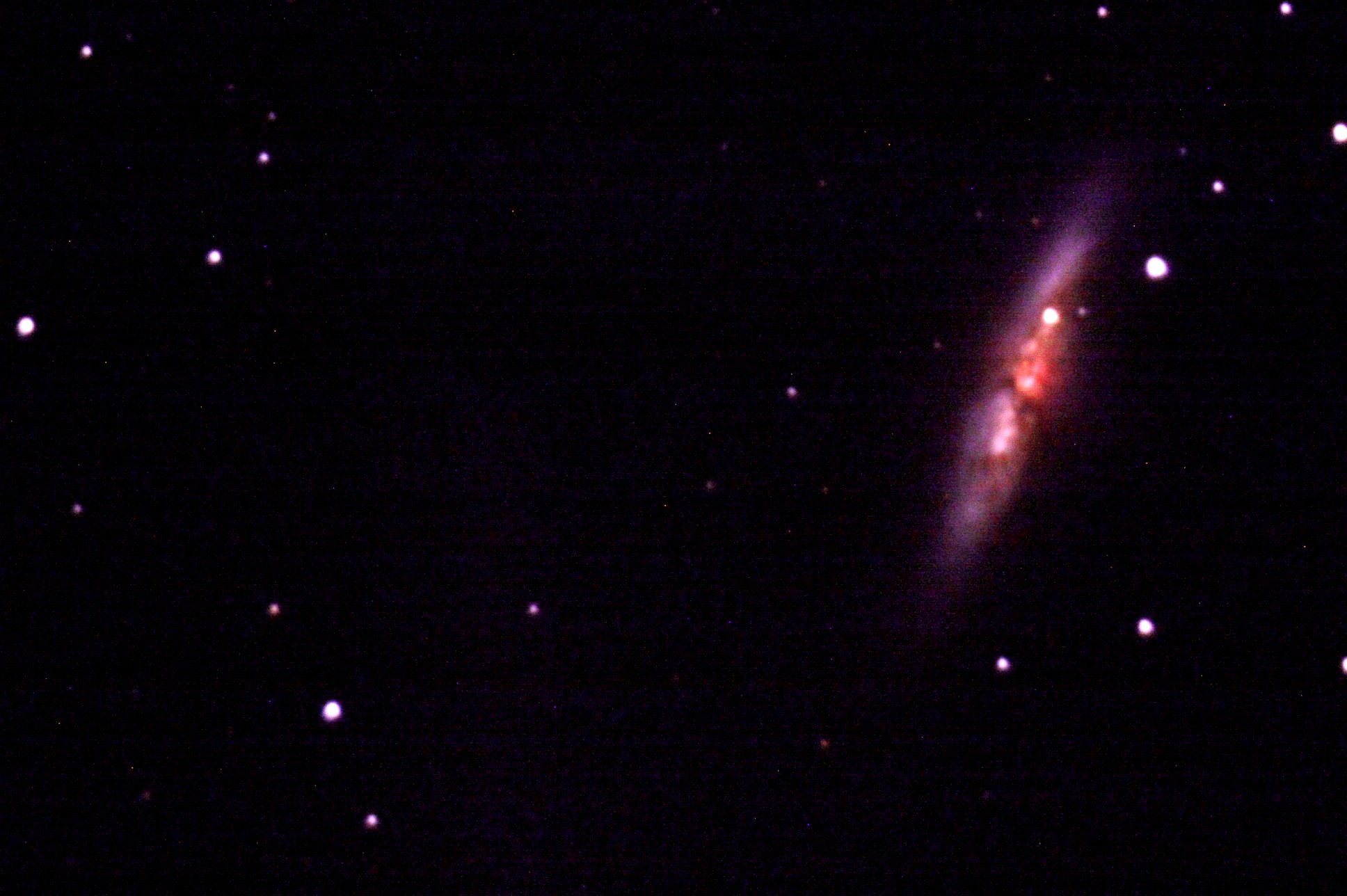
M 82 Super Nova 1/24/2014
Taken by one of the SMAS club members on 1/24/2014, Super Nova in M 82. This is a 3 minute exposure. The super nova is not naked eye visible, but has been seen by telescopes as small as 4 inches. Click here for more information on the M82 Super Nova. This is a type Ia and is one of the closest observed super nova in several decades. M82 is also known as the Cigar Galaxy and is found near the Big Dipper in Ursa Major by its companion galaxy M81.
-
Scott Alan Sandness (1956 – 2013)
Posted on January 17th, 2014 No comments Scott Alan Sandness, 57, of Belgrade, passed away on Dec. 31, 2013. He was born Dec. 27, 1956 in Valley City, N.D. to Theodore (Ted) and Pauline (Polly) Sandness.
Scott grew up on the family farm in the LaMoure, N.D. area. He graduated from LaMoure High School in 1975 and moved to Fargo, N.D., where he earned a degree in electronics from the community college. He also attended North Dakota State University before moving to Billings, Mont. where he did electronics repair and sound system installations. In 1986, Scott moved to Bozeman and attended Montana State University graduating in 1990 with a degree in electrical engineering. He worked as an electrical engineer for several years before his fascination with astronomy and star-gazing led to him opening a telescope store called Night Skies in Belgrade. Scott was a long-time member of the Southwest Montana Astronomical Society and helped many people get started in astronomy. He would get a big grin having people take their first look through a telescope and seeing the rings around Saturn. Not being afraid to try out different careers, Scott’s last job was as a sales person at Carquest in Belgrade which he greatly enjoyed.
Scott’s life-long love of music was inspired by his mother. He was an award-winning trumpet player, sang in various choirs, and was part of a barber shop quartet called “A Half Ton of Harmony.” He loved 1970’s rock and roll music playing on his JBL speakers. Throughout the years, Scott enjoyed hiking, bicycling, and most of all he was an avid golfer and Minnesota Viking fan.
Scott was a member of the Bozeman Church of Christ, where he enjoying singing, leading worship, and working the sound board for church services. His faith in God and the support of family and friends kept him enjoying life while going through his long battle with cancer. He had a tremendous influence for good in the lives of countless people.
Scott married Rose Bishop in 1993. They lived in Belgrade and divorced a few years later. Scott was preceded in death by his parents, Pauline and Theodore Sandness, and his brother and sister, Peter and Vicki, who passed away shortly after birth.
Memorial services will be held at the Bozeman Church of Christ on Monday, Jan. 6 at 2 p.m. Memorials in Scott’s name may be made to the Bozeman Church of Christ, 1825 W Kagy Blvd., Bozeman, MT 59715.
Scott was also a long time member of SMAS, he will be missed.
-
Astronomy at the high school
Posted on January 12th, 2014 No commentsPosted:
GAIL SCHONTZLER, Chronicle Staff Writer
Somewhere in the Milky Way galaxy, far, far away, baby stars are being born, and two Bozeman High School students have spent months working to uncover some of their mysteries.
Hannah Cebulla and Maddie Kelly just returned from a trip funded by NASA to present their research at the American Astronomical Society’s January meeting in Washington, D.C.
More than 3,000 scientists, professors, graduate students and college undergraduates attended – along with a handful of high school students.
“It was fantastic,” said Kelly, 17, a senior. “They were really impressed with the work we were able to do at our age.”
“For me it was real cool to see everybody’s hard work,” said Cebulla, a junior. “Everybody is so excited to see everybody’s research.”
They were two of about a dozen high school students from Connecticut, Virginia, Chicago and Bozeman who collaborated in researching “Class O/I Protostars and Triggered Star Formation in NGC 281.”
Basically that means they studied baby stars, the different ways stars form and whether those differences create any differences once they’re “adult” stars, the two students said.
Lynn Powers, library secretary at Bozeman High’s Bridger Alternative Program and Astronomy Club adviser, said it’s exciting for students to be doing original research, “not knowing what they’re going to find,” instead of repeating experiments others have already done and the outcome is known.
“It teaches students how to do science, do critical thinking, and take real live data and analyze it,” Powers said. “That’s amazing.”
Astronomy has changed from the days of looking through telescopes with the naked eye. Today astronomers look at computer screens and analyze data, said Powers, an avid amateur astronomer and Southwest Montana Astronomical Society president.
The Bozeman High students analyzed data from the Herschel telescope, named for the scientist who discovered invisible infrared radiation in 1800. The Herschel telescope has gathered thousands of hours of data that have been archived because NASA doesn’t have enough people to analyze everything. So the space agency has invited citizen-scientists to help out.
The students looked at stars forming in clouds of swirling gas and dust in an area near Cassiopeia called NGC 281. It’s nicknamed the Pac-Man Nebula because its shape resembles the video game character.
Last June the Bozeman students traveled to Caltech in California to learn how to do Python computer programming to analyze the Herschel data. They met the other high school students on their team, who continued to work together in the ensuing months using Skype and teleconferences.
Powers said she hopes the Astronomy Club can keep working on the project in the coming year. The club will probably have to do some fundraising, she said, because NASA’s education and outreach money has been “zeroed out” of the federal budget.
Kelly said she has always loved science and participating in the research conference “really drives your passion.” She plans to attend Montana State University and study astrophysics.
Cebulla said she first became interested in astronomy on family camping trips, when she’d look up at the stars and think they were “the coolest thing ever.” She plans to attend college and study astrophysics or astrobiology.
Powers said she and the students enjoyed visiting the Smithsonian’s National Air and Space Museum, but the coolest moment of the trip for her was meeting Neil deGrasse Tyson of the Hayden Planetarium and a host of NOVA science shows. She got his autograph.